As a professional domestic manufacturer of thermal printers, Lujiang Technology has keenly sensed the massive changes AI will bring to the printing industry. In recent years, it has kept increasing R&D investment for integrating AI into thermal printers.
It introduced AI image‑enhancement functions for the A46S tattoo thermal printer. Paired with its 203 dpi thermal print head, it effectively improves the clarity of tattoo stencil printing. For the C50 model, AI sketch‑to‑image capability is implemented, which instantly generates graphics from hand‑drawn doodles.
This year, responding to modern‑day parents’ concerns over children’s excessive exposure to smartphones, tablets and online content, Lujiang Technology has innovatively embedded AI into thermal printers and launched its new‑generation AI‑powered educational product — the AI50 smart thermal printer.
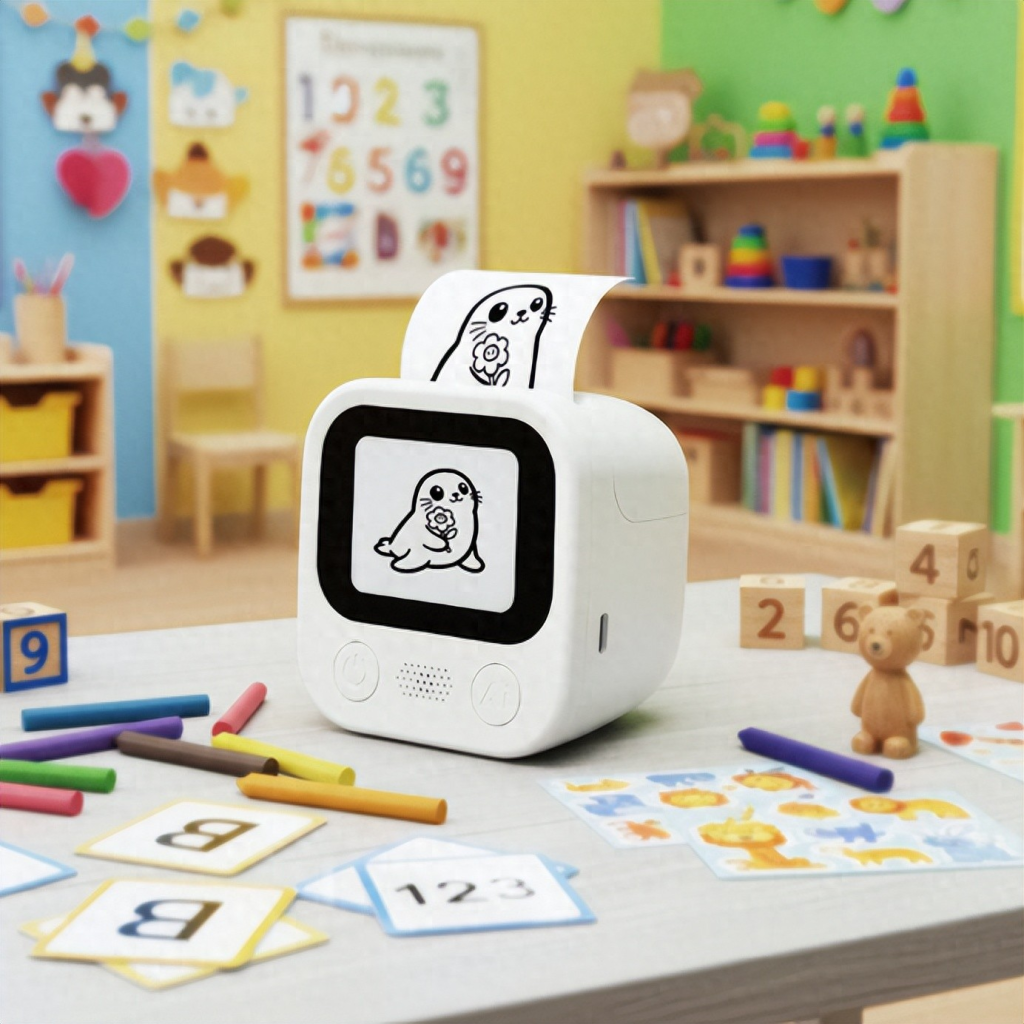
The AI50 is a 2‑inch AI‑voice‑controlled portable thermal printer designed for children aged 3‑12. It operates entirely via pure voice interaction without requiring any APP installation. By design, it cuts off access to short‑video platforms and mobile games.
Its core creative workflow is straightforward: children describe their ideas by voice; AI understands the input and generates graphics; the thermal printer outputs line art sketches; children then color the printed paper to finish their creation. Instead of grabbing kids’ attention, technology here turns fleeting imagination into tangible sketches on paper.
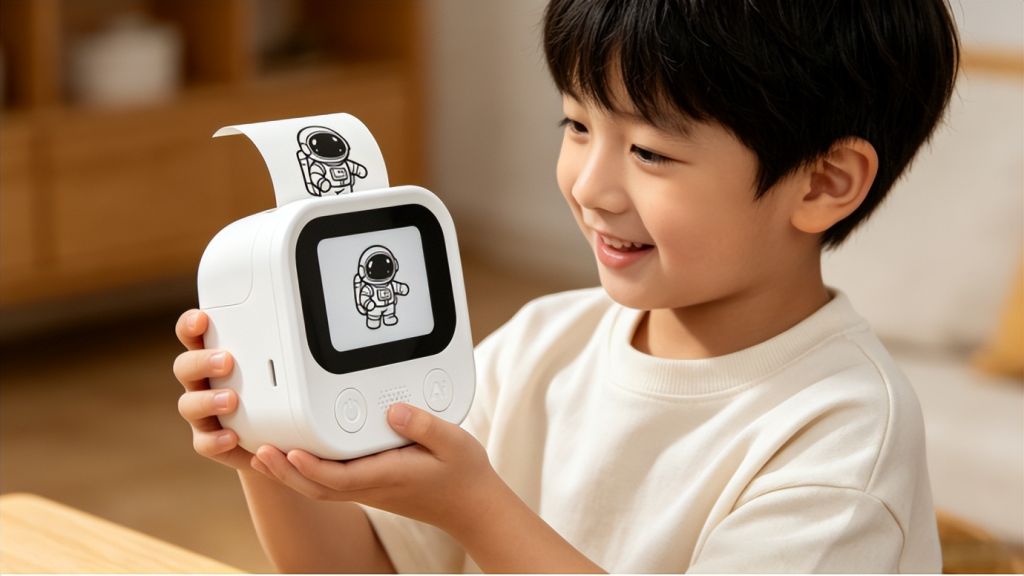
Children’s curiosity about the world often comes in the form of questions, and some concepts cannot be fully explained by words alone. For example, after hearing a story about gravity, a child may ask: “What would the world look like without gravity?” The kid can describe the imagined scene to AI50: people floating in mid‑air, ice‑cream flying away, a kitten clinging tightly to a table leg. Within seconds, the thermal print head outputs a line drawing full of these floating elements.
Once visualized on paper, abstract “what‑if” thoughts become concrete. As kids color the picture, they start thinking about objects and spatial relationships. They may further ask “why do astronauts float in outer space?” or even redesign the logic of their drawings. No screen dominates their attention in this process; thinking unfolds naturally on paper.
Printing is not the end of creation. The AI50 supports water‑transfer printing. Kids’ colored artwork can be transferred onto skin or other objects. The specially‑formatted water‑transfer paper is non‑toxic and safe; patterns wash off easily with soap and water, suitable even for kids with sensitive skin.
Creation thus becomes portable “social currency”. When a child sticks their hand‑colored “zero‑gravity‑world” sticker on their hand and brings it to school or playdates, conversations around that story and artwork spring up. Kids share physical creations and engage in face‑to‑face talking and listening, rather than chasing likes or comments on screens.

For school‑age children aged 6‑12, AI50 also features label‑printing and AI error‑question sorting functions. It helps organize exercise mistakes and summarize knowledge points, evolving this compact gadget from a creativity toy into a practical learning assistant. Requiring no external power supply or cables, it is compact and portable. Kids can simply slip it into a schoolbag for multi‑scene use on the go.
From AI voice‑driven image generation to thermal output, the AI50 is not meant to replace children’s drawing or thinking. Instead, it offers a gentle nudge at the very moment imagination sprouts, giving form to vague ideas hard to describe or draw by hand.
When a printer can “understand” children’s words and turn them directly back onto paper and coloring sheets, it does not extend screen time. Instead, it expands space for imagination to be seen, shared and re‑imagined.
The launch of AI50 marks Lujiang Technology‘s latest achievement from its continuous R&D in the thermal‑printer sector. Through independent innovation, the company has brought AI‑printer integration into practical real‑world applications, breaking traditional industry boundaries and opening new opportunities for the thermal‑printing industry.